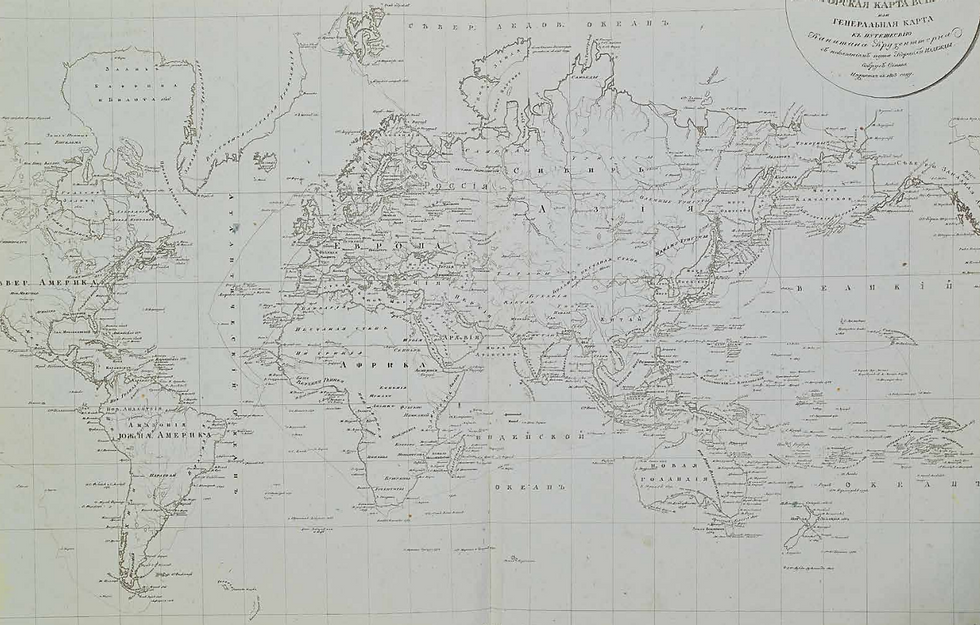

KRUZENSHTERN, Ivan Fedorovich
Reise um die Welt in den Jahren 1803, 1804, 1805 und 1806 auf den Schiffen Nadeshda und Newa. [Puteshestvie vokrug sveta v 1803, 4, 5 i 1806 godakh na korabliakh Nadezhde i Neve.]
The first Russian circumnavigation and “one of the best – one may say magnificent – examples of Russian printing and engraving of the nineteenth century” (Lada-Mocarski).
Publication details:
St. Petersburg, for the author at the Schnoor press, 1810-1812 [text], 1814 [atlas].
Information:
4 volumes: 1 folio atlas volume (603 by 465mm), and 3 quarto text volumes (254 by 210 mm).
Text: with the half titles, the subscribers’ list, and the folding table; bound in contemporary tree half calf over brown marbled paper boards, smooth spines gilt at the ends and with a cornucopia tool in the main compartment, tan morocco labels, Atlas: occasional small dampstain in some margins; some small marginal repairs; plates 85 and 96 with a repaired tear reaching into the image; the title page with a dampstain and small repair in the bottom corner, not affecting the text; neatly rebacked preserving the original spine; small repairs at the extremities. Text: volume 2 with a repaired tear in the half title and title; the same volume with marginal dampstains in the first and last gatherings, and occasional light marginal spotting; neat repairs to some joints and corner; sides lightly scuffed; one board with small area of paper loss.
Atlas:
Double-page world map and 109 plates, all with captions in Cyrillic, most with additional captions in German; most with plate numbers in Roman numerals, some without plate numbers; 33 of the plates, mainly maps and coastal profiles, printed on thick blueish paper; contemporary – probably original — green hard-grain morocco, the upper side titled in gilt within gilt and blind paneling with floral corner tools, the lower side paneled in blind, flat spine gilt in compartments with thick-andthin filets and divided by thick blind rules, edges gilt, white moiré style endpapers.
Literature:
Lada-Mocarski, 61-62 (giving the wrong
reference for Obol’ianinov [1835 instead
of 1385] and misquoting the plate count);
Smirdin, 3707; Sopikov, 9202; Svodnyi
Katalog, 4129; Tremaine, 9378.
Notes:
The rare first edition, German version, of the first Russian circumnavigation of the globe, published simultaneously in Russian.
Kruzenshtern’s atlas is an outstanding accomplishment of Russian cartography and travel illustration, and “one of the best – one may say magnificent – examples of Russian printing and engraving of the nineteenth century” (Lada-Mocarski).
Here the atlas is in the earliest variant known for this issue: the world map is dated 1813 (rather than 1815 or 1818), and all the maps and coastal profiles have captions in Russian only. Nearly all the maps in this copy are printed on thick, bluish paper. RBH and ABPC record no other copy of the atlas having ever been offered at auction. Kruzenshtern’s voyage is one of the most important after Cook, and is especially valuable for its description of the Northwest coast of America and of the North Pacific.
The expedition greatly improved cartographic knowledge but had much grander objectives: Kruzenshtern envisioned that, while exploiting this region’s resources – mainly fur – and trading these with China, Russia would develop its own, home-grown navy and finally shed its troubling dependence on Britain for personnel and training.
This ambitious expedition also set out to examine the viability of colonizing California, aimed to improve trade in South America, and to open relations with Japan and the Sandwich Islands. As Hill reports: “appointed to command the first Russian round-the-world expedition, had serving with him a brilliant corps of officers, including Lisiansky, Langsdorff, and Kotzebue. The expedition was to attempt to ‘open relations with Nippon and the Sandwich Islands, to facilitate trade in South America, to examine California for a possible colony, and make a thorough study and report of the Northwest coast, its trade and its future.’...The importance of this work is due to its being the official account of the first Russian expedition to circumnavigate the globe, and the discoveries and rectifications of charts that were made, especially in the North Pacific and on the northwest coast of America....The introduction is particularly important and interesting because of the information it contains respecting the state of Russian commerce during the eighteenth century, the Russian voyages and discoveries in the Northern Ocean, and the Russian fur trade”.
Kruzenshtern served with the English Navy against the French, as a Russian volunteer, in the revolutionary war of 1793-1799. During that time, he observed how important trade between England, the East Indies and China was; and how fortunes were being made by fur skins to China from the Northwest coast of America, where Russia had its own colonies, and began to anticipate a time when Russia could participate at the same level. In 1784, Grigory Shelikhov (1747-1795) had established Russia’s first permanent North American settlement, the Three Saints Bay Colony, on Kodiak Island in Alaska. The Russian-American Company was established in 1801, and rapidly began asserting a monopoly over Alaskan trade, which it didn’t relinquish until Alaska was sold to the United States in 1867. Shelikov’s daughter, Anna, had been married to Nikolai Resanov, who vigorously promoted the project of Russian colonization of Alaska and California, and accompanied Kruzenshtern on his voyage.
Kruzenshtern, in command of two vessels, the ‘Nadeshda’ and ‘Newa’, sailed from Kronstadt, the main seaport of St. Petersburg, where the Tsar came to wave them off, and sailed west to Copenhagen, then Falmouth, crossing the Atlantic Ocean and stopping only once at Teneriffe, before reaching Santa Cruz in Brazil. During the winter of 1803-1804, they made their way to the Marquesas Islands via Santa Catharina Island and Cape Horn. Kruzenshtern then headed for Hawaii, perfectly located to serve as a refueling station for ships sailing north to China or the northwest coast of America. It was, and is, the hub of the pacific, being almost equidistant from Japan, Alaska, and New Spain.
Kruzenshtern was assisted by Yuri Lisianskii, Langsdorff and Kotzebue. The expedition separated once it reached Hawaii: Lisianskii sailed to the Northwest coast aboard the Neva, and Kruzenshtern continued to Japan – a journey that required considerable diplomatic sensitivity at a time when Japan was still a closed country. From there he sailed to Macao and Canton, where he was joined again by the ‘Newa’. The atlas includes very fine views of Kruzenshtern’s voyage. In the meantime, Lisiankii had sailed from Hawaii in June of 1804 before heading on to Kodiak Island in southwestern Alaska, where the expedition spent a month. In August 1805, he crossed to the Russian settlement at Sitka, in southeastern Alaska, for which Lisiansky had brought a shipload of supplies. After spending the autumn at Sitka, he crossed in November 1804 back to Kodiak to spend the winter and the spring of 1805. In June 1805, he returned to Sitka for the summer, leaving on September 1, 1805, for China, where the two vessels were reunited, sailed to St. Helena and back to Europe. Lisianskii published his own account of the voyage in 1812.
Lada-Mocarski notes that “in different copies of the same issue […] the number and the type of plates vary considerably”. He gives the typical range as between 106 and 112 plates, quoting Obol’ianinov as his source for the higher number, but this is incorrect: Obol’ianinov lists 109 plates only. The copy in the Library of Congress, the Russian version originally in the Palace Library at Tsarskoe Selo, lists a total of 110 plates.
The Greene copy and the Library of Congress copy appear to be the only two in the U.S. with this maximum number of plates.
A full collation is available on request.